
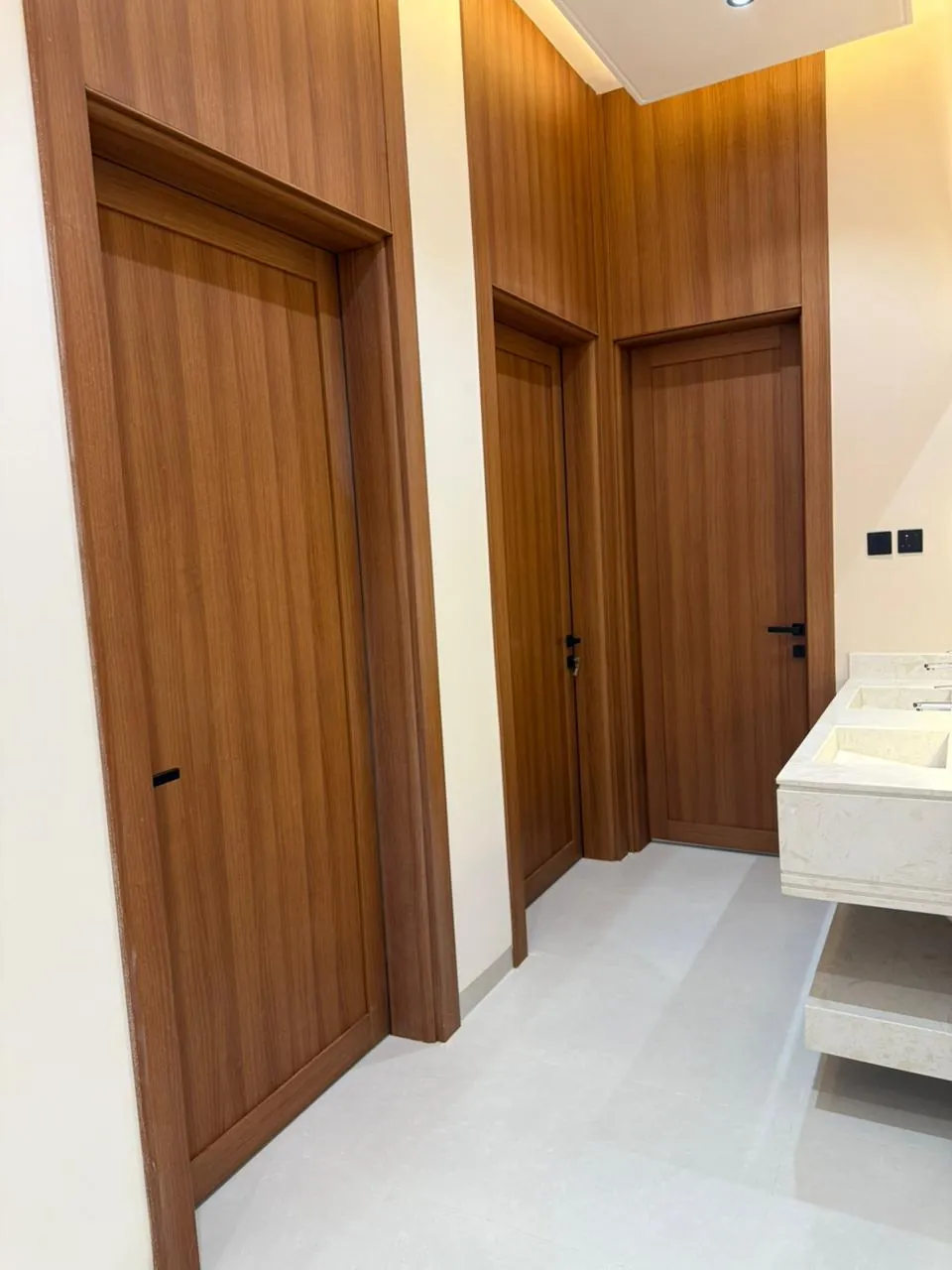
Sliding doors in modern villas come in three main types: pocket doors that vanish into the wall, surface-mounted doors on a visible rail, and doors on a concealed overhead track that hides the rail in the ceiling. They save swing space but seal sound less well than hinged doors and need early planning.
Why sliding doors suit villas
Modern villas link living, dining and kitchen areas in open spaces. A sliding door opens or separates them as needed, with no swing arc, which suits kitchens, dressing rooms and partitions between majlis and family areas.
Three types of sliding door
Type 1: Pocket doors
The door slides into a cavity in the wall and is invisible when open. Pros: the cleanest look possible, and no visible wall area lost. Cons: it needs a wall thick enough to hold a cavity about the width of the door, switches and outlets cannot sit in the pocket zone, and reaching the rollers is hard unless a service hatch is designed in.
Type 2: Surface sliding doors
A door hangs from a rail fixed on or above the wall and slides in front of it. Pros: simplest to install and often the least costly, workable in an existing house, and decorative if the rail is well chosen. Cons: the rail and fittings stay visible, a clear wall length equal to the door width is needed, and light and sound sealing are weaker because the door sits slightly off the wall.
Type 3: Concealed overhead track
The rail is recessed into the ceiling or an overhead pocket with a shadow gap, so the door appears to move unsupported. It is the usual choice for full-height doors. Pros: a contemporary look without visible hardware,. Cons: it needs early coordination with the ceiling and structure, structural support above the opening to carry the weight, more precise installation, and a service hatch for later repairs.
| Criterion | Surface | Concealed overhead | |
|---|---|---|---|
| Rail visible? | No | Yes | Hidden |
| Space needed | Wall depth and cavity | Clear wall length | Ceiling coordination |
| Retrofit to existing house | Difficult | Easier | Moderate |
| Sound insulation | Moderate | Usually weakest | Moderate with seals |
| Best for | Standard, lighter doors | Decorative doors | Full-height doors |
Soundproofing
A sliding door does not close against a tight frame the way a hinged door does, so gaps remain around the edges and underneath. Improvement comes from several measures together:
- A heavy door with a solid or insulated core instead of a hollow leaf.
- Brush or rubber seals along the top and sides.
- A drop-down bottom seal that lowers on closing, or a double overlapping leaf.
Even so, for a room needing strong insulation, such as a home cinema, a heavy hinged door is the better choice.
Hardware that makes the difference
Hardware quality decides whether a door stays smooth and quiet or starts to rattle after a year. Look at:
- Track and rollers: aluminium or steel track with ball-bearing rollers rated for the door’s weight.
- Soft-close and soft-open: prevents slamming and protects the door and frame.
- Handles: recessed pulls that do not obstruct travel, with a privacy lock for bathrooms and bedrooms.
- Floor guide: stops the leaf swinging; keep it small and easy to clean.
Where to use each type
- Master suite and dressing room: pocket or concealed track, to save circulation space.
- Kitchen: surface or concealed track, to close it off from the lounge while cooking.
- Majlis and family lounge: a full-height door on a concealed overhead track gives an elegant separation when needed.
How ControlMax handles sliding doors
Our doors and joinery service covers room doors, full-height doors, sliding doors on hidden tracks and overhead cladding. What sets us apart is that finishing and technology are planned together: cables, power supplies and control points are prepared inside the wall or frame before it is closed, with one team under one contract. If you plan to motorise doors or add digital locks, our main smart-home site shows how those systems fit together.
The path runs from a free site visit to design and working drawings (including lighting and systems), a detailed quote and schedule, supervised build, and handover.
Frequently asked questions
Does a sliding door block sound as well as a hinged door?
Usually not to the same degree, because a sliding door does not seal against a full frame and small gaps remain at the edges and bottom. Heavier doors with suitable cores, brush or rubber seals and a drop-down bottom seal help, but results stay short of a studio-grade seal.
What is the difference between a pocket door and a concealed overhead track?
A pocket door slides into a cavity in the wall and disappears fully when open. A concealed overhead track is fixed in the ceiling or a recess above, so the door stays visible on the wall but the rail does not show. The first needs wall depth; the second needs early ceiling coordination.
Does a sliding door need maintenance?
It needs periodic cleaning of the track, a check on the rollers with lubrication when required, and adjustment of the soft-close and seals. This matters more in Riyadh, where dust works into rails, so design a track that is easy to reach.
How large can a sliding door be?
Size is limited by the door’s weight and the rated capacity of the track and hardware, not by design alone. Full-height doors are heavier and need structural support above and load-rated fittings. Ask the manufacturer for load tables and confirm the structure can carry them.
Can a smart lock or motor be fitted to a sliding door?
Yes, but it must be planned early so cables and a power supply can be routed inside the frame or wall. Motors, handles and digital locks exist for sliding doors, and the choice depends on the door’s weight and how it is used.
Where should sliding doors not be used?
Avoid them where a tight seal against sound, smell or smoke is needed, and on escape routes where they would conflict with safety rules. Check the Saudi Building Code and civil defence requirements when a door sits on an exit path.
About ControlMax ControlMax is a Saudi company based in Riyadh offering smart homes, security and networks, with an interior fit-out and finishing division. Contact: unified number 920017618 · WhatsApp +966 59 611 4050 · Building 6604, Tabuk St, Al Izdihar, Riyadh 12485. Book a free site visit.